
Quick Facts:
- Lists menu items under $10.
- Free to use, donation supported.
- UGC powered, submit restaurants + vote.
- Focused on family owned restaurants.
- Built by a DFW developer laid off due to Artificial Intelligence.
After nearly two decades in corporate America, North Texas engineer Jae Park found himself facing an unexpected career change. Now, he is using his experience with artificial intelligence and automation to build a new platform designed to help consumers find affordable meals at locally owned restaurants.
Park spent 18 years working in the corporate technology world and eventually became a task force leader responsible for implementing AI and automation within his organization. As those technologies became more capable, Park says his own position was eventually eliminated.
There is an interesting irony to his story. Rather than turning away from AI after losing his job, Park decided to use the technology and expertise he had developed to create something of his own.
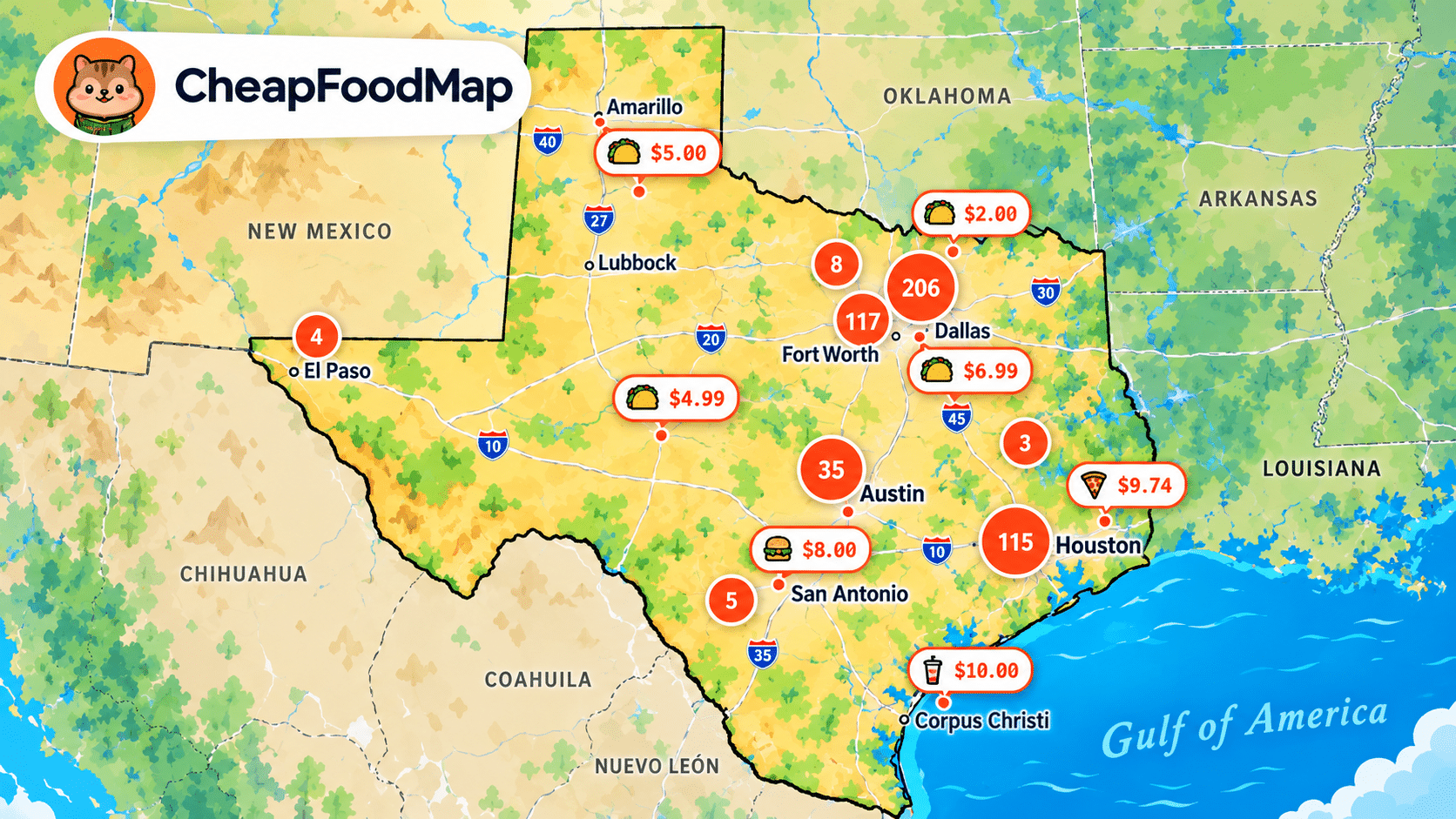
The result is CheapFoodMap, a free, crowdsourced website and app that helps users locate restaurants offering meals for less than $10.
From Corporate Engineering to CheapFoodMap
Losing a long-term position was not an easy transition for Park.
He was supporting a family of four, including a daughter beginning college and another still in high school. Park said the layoff affected him emotionally and changed the way he viewed himself for a period of time.
But his experience working with automation also gave him a useful set of skills for whatever came next.
Park had already seen how quickly modern AI tools could help people develop software, process information and automate tasks. Instead of immediately trying to recreate his previous corporate career, he began experimenting with the idea of building a consumer product.
CheapFoodMap emerged from a relatively straightforward problem: eating out has become increasingly expensive, while many independent restaurants are simultaneously trying to attract more customers.
Park’s platform attempts to connect the two.
Restaurants and users can contribute affordable menu options, creating a map of places where someone can still find a meal for less than $10. The service focuses primarily on local and family-owned restaurants rather than large national chains.
The Project Requires More Than AI
Although technology helped Park create the platform, much of the work required to make CheapFoodMap useful happens offline.
Park visits restaurants throughout the Dallas-Fort Worth area, speaks with owners, identifies qualifying menu items and promotes participating businesses through social media.
For someone who describes himself as relatively introverted, that has also meant taking on a very different role from the engineering work he spent much of his career performing.
Instead of working primarily behind a computer, he is now regularly meeting restaurant owners and customers while trying to build awareness of the platform.
The project has already accumulated hundreds of restaurant listings and has begun expanding beyond North Texas.
A Crowdsourced Approach to Affordable Dining
CheapFoodMap ultimately depends on participation.
Rather than attempting to maintain a complete database himself, Park’s goal is to create a community-generated resource where people can add inexpensive meals they discover.
That model could become particularly useful as restaurant prices continue to fluctuate.
The $10 threshold also gives the platform a simple purpose. Users are not necessarily searching for the cheapest restaurant overall or comparing extensive menus. They are looking for specific places where they know they can still purchase a meal without spending much more than ten dollars.
For participating restaurants, appearing on the map could provide another way to introduce themselves to customers who might otherwise never find them.
Can It Become a Business?
The larger question for Park is whether CheapFoodMap can eventually become financially sustainable.
The project currently costs him roughly $200 per month to operate, according to reporting about his story, and Park says his family has given him a limited amount of time to determine whether the idea can develop into a viable business.
That makes CheapFoodMap as much a startup experiment as it is a technology project.
Park is testing something nearly every entrepreneur eventually has to answer: whether an idea that sounds useful actually solves a problem strongly enough that people will continue using it.
In Park’s case, that means getting enough restaurants and consumers involved to make the map increasingly valuable as the database grows.
AI Changed His Career — But It Also Helped Shape What Came Next
Park’s experience offers a more nuanced example of how artificial intelligence is beginning to affect the workplace.
AI and automation played a role in changing the type of work available within his former organization. At the same time, the knowledge Park gained implementing those technologies gave him the ability to develop a new product much more quickly than might have been possible in the past.
That does not necessarily make losing a long-term job easier.
But it does illustrate something that may become increasingly common as AI adoption spreads through businesses: the technology may eliminate or change certain roles while simultaneously lowering the barrier for experienced workers to build entirely new products, businesses and services.
For Park, that transition currently looks less like replacing engineering with another engineering job and more like combining technology, entrepreneurship and a decidedly low-tech activity — visiting local restaurants one at a time.
Whether CheapFoodMap eventually becomes a sustainable business remains to be seen.
For now, Park is using the same technological shift that disrupted his corporate career to see if he can build his next one.
Featured image by Texas is Life